


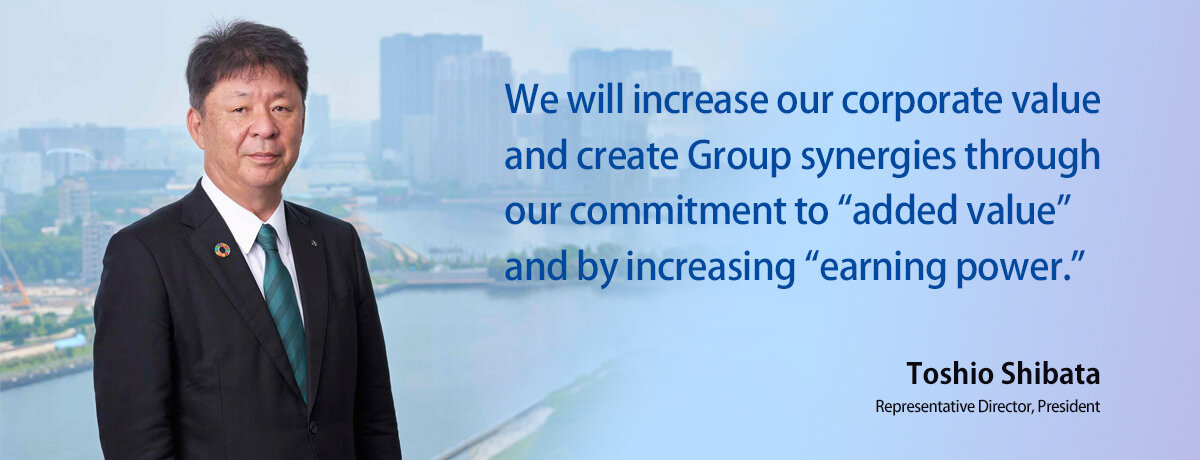
In the fiscal year ended March 31, 2025 we returned to
the black by recording a slight profit amid increasingly severe structural issues in the construction industry.
Fiscal 2024 witnessed a challenging external environment as the structural issues facing the construction industry worsened. Prices for construction material prices hovered at high level due to rising global energy and resource prices. Furthermore, construction costs, including labor costs, also increased and these conditions are expected to persist for the time being.
Tight labor market is now becoming an increasingly conspicuous problem. On top of this, the aging of skilled labor at construction sites and the decline in the number of young workers have accelerated. In the previous fiscal year, skilled workers were concentrated at large-scale construction projects such as redevelopment projects in metropolitan areas and at semiconductor plant and data center projects in regional areas, which further aggravated the nationwide labor shortage. Although work style reforms have advanced significantly thanks in part to government guidance, problems such as rising labor costs and a shortage of human resources are also becoming more serious. To revive the appeal of the construction industry, it will be essential to improve work conditions as well as raise wages in accordance with actual work conditions. I am hoping for the implementation of national policies and the understanding of privatesector clients in these areas.
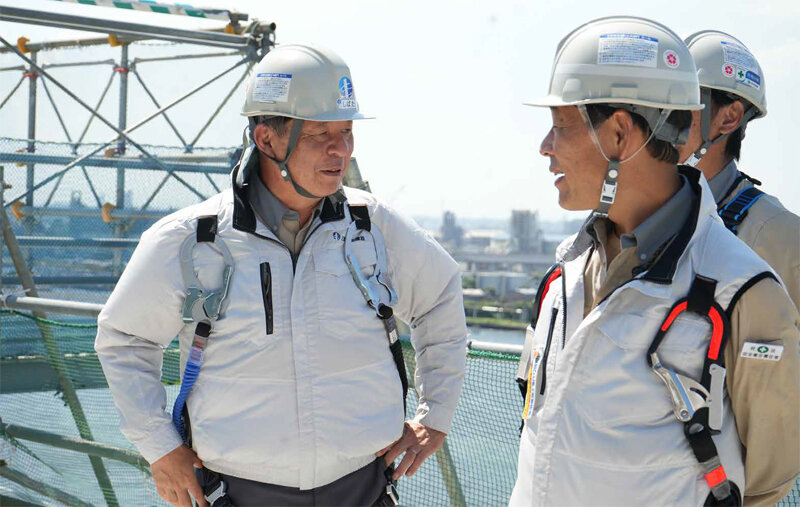
Turning to our business operations in fiscal 2024, I first wish to apologize for any concerns we caused to stakeholders relating to the large-scale domestic building construction project that resulted in a significant loss. After the framing for this building was raised in September 2024, the project has been moving ahead according to schedule. We aim for completion of the main construction in August 2025 and for delivery at the end of October. In undertaking this project, there was an error at the super-high-rise residential building, which is one of our fields of expertise. However, after reorganizing our internal structure, we responded to this problem by making Company-wide efforts to complete this super-high-rise residential building, the tallest in Japan. Our technologies for rapid construction enabled the framing to be built one floor at a time in as quickly as three days all the way up to completion. This, and our ability to develop and implement various new technologies during the construction process, proved to be a great asset and provided confidence to both the employees involved in the project and the Company. Heeding the lessons learned from our experience with this project, we intend to continue our work on super-high-rise residential buildings with a careful eye on future projects.
At the time we released our interim financial results for the fiscal year ended March 31, 2025, we also forecast a full-year deficit due to the previously mentioned loss on the large-scale domestic building construction project. However, during the second half of the fiscal year, we achieved a significant turnaround in the performance of our Domestic Civil Engineering and Overseas businesses. In our Domestic Building Construction Business, we also sharply improved profitability on other construction projects. Consequently, we were able to return to the black by recording a slight profit. The impact of foreign exchange rates was also an external factor underlying these results. As an internal factor, I believe that this turnaround also resulted from the permeation of our policy of "go back to the front line," which I have been advocating during the past one year and several months since assuming the duties of president. Improved profitability in each business division also made a contribution. We have implemented a variety of measures in response to the loss on the large-scale domestic building construction project. These include strengthening our order-taking process, implementing profit-focused sales policies, and front-loading our work from the initial stage. Going forward, we will continue to improve our business operations and aim to increase earning power.
During the past three years, we achieved noteworthy results with our initiatives of Improve earning power, Take on challenges in growth areas, and Enhance the human resource base.
Under our Mid-term Management Plan 2022-2024, which ran through fiscal 2024, we promoted three themes consisting of Improve earning power, Take on challenges in growth areas, and Enhance the human resource base.
First, regarding "Improve earning power," our overall figures fell short of the targets due to a significant loss on the large-scale domestic building construction project. Nonetheless, we recorded favorable results in our Domestic Civil Engineering Business. This includes posting record-high profits in fiscal 2023, centered on PC bridges, large-scale renovation work, and tunnels, which are our fields of strength. In the Domestic Building Construction Business, we are reorganizing its order portfolio by completing the order backlog and replacing these with high-quality projects by accepting orders that emphasize profitability. As a result, excluding the large-scale domestic building construction project, our profit margin at the time of order receipt has improved to over 7%.
Regarding the second theme, "Take on challenges in growth areas," we have unfortunately had to limit various growth investments, such as for technology development, due to a deteriorating business performance in the past In the fiscal year ended March 31, 2025 we returned to the black by recording a slight profit amid increasingly severe structural issues in the construction industry. During the past three years, we achieved noteworthy results with our initiatives of Improve earning power, Take on challenges in growth areas, and Enhance the human resource base. Message from the President 4 SUMITOMO MITSUI CONSTRUCTION Integrated Report 2025 SUMITOMO MITSUI CONSTRUCTION Integrated Report 2025 5 Value Creation Story Strategies for Value Creation Foundation for Value Creation Data several years. On the other hand, our Overseas Business, which is the flagship of our growth field, is achieving important results, as evidenced by an expansion of its business scale to 100 billion yen in fiscal 2023. Additionally, our floating solar power generation business that aims to contribute to a sustainable society has steadily evolved although the size of this business is still small. Current power generation capacity in this business is 17.3 MW.
Finally, regarding "Enhance the human resource base," we first of all formulated a Diversity & Inclusion (D&I) Policy and held educational and workshop activities to firmly establish this policy. We also hired foreign national graduates from overseas universities as full-time employees and established global Human Resources Development Centers (HDCs) at multiple global locations to provide education.
The biggest remaining issue is human resources. In particular, we have an unbalanced workforce composition with very few employees in their late 30s and early 40s. As such, there is little remaining time for veteran employees to pass the baton to younger employees and this is an urgent issue we must address.
Our decision to undertake business integration with INFRONEER Holdings Inc. aims at resolving a variety of issues faced and quickly recovering impaired capital
I will now explain the background behind our business integration with INFRONEER Holdings. In recent years, we have encountered structural challenges common to the construction industry, including a labor shortage, persistently high prices for construction materials, and tight labor market. Besides these, we also face issues unique to Sumitomo Mitsui Construction. These include the early recovery of our capital, which has been significantly impaired by losses on the large-scale domestic building construction project, and rapidly increasing our corporate value. We initially considered tackling these issues by continuing to operate independently. However, we calculated that it would take seven to eight years to restore our capital, especially impairments, even if we consistently generate profits under current conditions. After considering these factors, we decided that our best choice would be to expand our business base over the medium to long term by realizing synergies through business integration with INFRONEER Holdings and attaining a more-reliable and accelerated enhancement of corporate value.
The INFRONEER Holdings Group's current group strategy is to become an Integrated Infrastructure Service Company that undertakes operations in both the "Construction" business and "de-Construction" business markets. The "de-Construction" business goes beyond simply building things. Rather, this covers the entire scope of projects, from investment to operation and exit and includes public-private partnership (PPP) projects and renewable energy projects. Examples include concessions and PPPs for roads and airports, arena and stadium operations as well as for power generation projects. Although domestic public works projects and infrastructure maintenance and renovation projects known as "Construction" businesses remain steady, investment in new public works projects is likely to decline over the long term due to factors such as the shrinking population, leading to intensifying competition. To survive in this market, engineering capabilities that enable comprehensive management from design to construction management and safety management are crucial. I believe that INFRONEER Holdings' proposal for the business integration was based on a high evaluation of our potential in these areas. I am confident that Sumitomo Mitsui Construction can fully meet their expectations and demonstrate its capabilities. Currently, our operations are focused on the "Construction" business. Now, as member of the INFRONEER Holdings Group, we will also be involved in "de-Construction" business areas over the long term.
Continuing our management policies and growth strategies after the business integration while accelerating growth leveraging Group synergies
I am not contemplating any major changes to our management policies or growth strategies as a standalone company even after business integration with the INFRONEER Holdings Group. We aim to accelerate growth by taking advantage of the benefits of integration in the "Construction" business field cultivated to the present.
The largest synergy derived from the business integration will be economies of scale, which will roughly double the scale of our Construction Business when combined with that of Maeda Corporation, the core company of the INFRONEER Holdings Group. As our business scale will be second only to major general contractors, I anticipate significant benefits in operating divisions, such as lower materials procurement costs and increased flexibility with partner companies.
In terms of individual businesses, first of all the business integration will create a highly complementary combination overall in the Domestic Civil Engineering Business, as we possess strengths in PC bridges and large-scale renovation work while Maeda Corporation has strengths in electric power civil engineering such as dams as well as in defense. Having two general contractors of our size under the umbrella of a single holding company is probably an unprecedented business format. This approach will enable us to offer a full lineup of services from upstream to downstream sectors in civil engineering, including tunnels, bridges, rivers, and water and sewerage systems. When also including the infrastructure operation business being promoted by the INFRONEER Holdings Group, I believe we will be uniquely position within the industry.
In the Domestic Building Construction Business, despite some similarities in our order portfolios, each company has its own customer network and clearly defined niches. Both companies have strengths in superhigh- rise residential buildings and there is some overlap in our clients, primarily developers. However, in light of the current robust housing demand and tight supply, the environment cannot be considered especially competitive and this means that any negative synergies resulting from business overlap will be limited. We boast a wealth of experience in super-high-rise residential buildings. By sharing our technical know-how, such as in precasting methods, I believe that the INFRONEER Holdings Group as a whole can secure an overwhelming share of the industry.
Turning to Overseas Business, although Maeda Corporation has not made significant inroads overseas, we undertake operations centered on Southeast Asia and South Asia. In these regions we are involved in infrastructure projects, primarily ODA projects, in civil engineering field, while in building construction field we focus mainly on plants for Japanese-affiliated companies. After the business integration, we will be well positioned to combine the technical know-how of the INFRONEER Holdings Group's infrastructure services with its own industry top-class track record and network, primarily in Asia. Looking to the future, we will have ample potential to expand our business domains to include PPPs and PFIs in overseas countries. Sumitomo Mitsui Construction aims to broaden its overseas business and I have high hopes this business integration will help accelerate our business expansion.
Focusing on "added value" and increasing our "earning power" while closely assessing our direction for medium- to long-term growth
The five directions we currently envision for Sumitomo Mitsui Construction's medium-to-long-term growth are as follows.
The first is domestic public investment. Although overall investment is likely to decrease in the future, I expect that the budget for strengthening national resilience will be maintained from the perspective of disaster prevention.
The second is the security sector. I anticipate that the domestic defense budget will be increased in the future. At the same time, we are also focusing on US militaryrelated construction work. The US military is planning to develop infrastructure for defense bases in the Oceania region. We have a solid track record in US military-related projects in Guam so we will keep a close eye on developments in Oceania.
Third is carbon neutrality. In this field, the recently announced Seventh Strategic Energy Plan calls for the use of decarbonized power sources such as renewable energy and nuclear power. Capital investments in hydrogen and ammonia, which are cited as a means of energy transition, are expected to become active in a relatively short period of time. We can leverage our track record in the design and construction of cryogenic tanks in these fields and we are already promoting sales activities. Furthermore, we are also implementing a feasibility study for concrete floating offshore wind farms in collaboration with a company that has a proven track record in France.
These directions that I have just explained are mainly in civil engineering field. In the building construction field, I anticipate that demand for building data centers and semiconductor plants will continuously increase in tandem with the spread of AI technologies. As both types of facilities have unique features and a variety of sizes, we are currently holding internal discussions regarding the domains we should target.
Finally, in our Overseas Business, demand for ODA infrastructure projects centered on Southeast Asia, in which we have participated, will likely remain firm for another five to 10 years. Looking beyond that, as a member of the INFRONEER Holdings Group, we will advance into infrastructure projects implemented by clients other than ODA-related projects, including those for the Asian Development Bank for example. We will also move into domains such as PPPs and PFIs that I mentioned previously and we are currently undertaking information gathering and research in these areas.
With a view toward these directions, we will maintain our commitment to "added value" and increase "earning power" for future growth. Our key strategies for realizing these will be to "deepen our core business" centered on the domestic civil engineering and building construction businesses and "expand our growth business" that encompasses overseas businesses and new peripheral fields. Concurrently, we will "strengthen the foundation for achieving growth" through human resources strategies and technology strategies.
Establishing a new Human Resources Development Division to strengthen human capital and fundamentally reviewing our personnel system
In strengthening our human capital, we will continue to focus on "Enhance the human resource base" as set out in our previous Mid-term Management Plan. In the past, the Personnel Department operated under the Administration Division and was responsible for recruitment and evaluations. Unfortunately, the division lacked the resources to handle matters such as human resources strategies. Furthermore, other human resources-related departments were dispersed throughout the Company. To improve this situation, we newly established the Human Resources Development Division in April 2025 and centralized human resources functions. At the same time, by shifting personnel from business divisions, we strengthened our system for promoting human resources strategies linked to business strategies.
A key mission of the Human Resources Development Division is to fundamentally review our personnel system. As one initiative, the division is preparing to abolish the current personnel system, which is heavily senioritybased, and transitioning to a system that rewards employees according to the weight of their responsibilities and the degree of their authority. This new system is scheduled to be introduced during the current fiscal year. Furthermore, as part of our focus on career recruitment, we have implemented measures such as systemizing "referral hiring and alumni recruitment" and introducing "360-degree evaluation" into our personnel evaluations in response to strong employee feedback. These measures will be implemented from fiscal 2025. Moreover, we continue to focus on promoting the participation of women with the aim of building an environment where diverse talent can play active roles. We have set KPIs for the ratio of women career-track employees and women managers and are making efforts in this area. Discussions are also underway to promote women to executive positions.
With regard to sustainability management, it is important to maintain a balance among the environment, society, and the economy and strive for sustainable development while earning the continued engagement of stakeholders, including customers, employees, and local communities. We continue to promote Company-wide initiatives to resolve issues in our business activities that have a particularly large social impact. One of these is carbon neutrality. In May 2025, we revised our Roadmap Towards Carbon Neutrality by 2050, which was formulated in 2021, to further accelerate our initiatives to address climate change across the entire Group. Alongside resolving important social issues such as "nature positive," a "circular economy," and "human rights," we are also working to strengthen the foundations for promoting sustainability management, including our governance system.
My mission as president is to interact closely with employees to achieve retention while successfully completing the business integration.
Among our stakeholders I have explained to our customers that the business integration will stabilize our financial base and they have positively shown their understanding. Furthermore, I will strive to enhance the corporate value of the entire Group by steadily achieving performance targets for INFRONEER Holdings, our sole shareholder. In this context, I believe that the most important stakeholders to focus on in moving toward the business integration are our employees. As such, my top priority is to dispel their anxieties and increase their motivation. As part of the recent integration, all directors, myself included, split up and visited offices across the country to explain the details and speak directly with employees. At first numerous employees were upset and perhaps not everyone is fully convinced yet. However, I feel we are creating an atmosphere conducive to positive discussions. I intend to share the progress of our discussions with INFRONEER Holdings with as many employees as possible, listen to their opinions, and reflect their ideas into our policies.
Although Sumitomo Mitsui Construction will become part of the INFRONEER Holdings Group, we will nonetheless retain our corporate legal status and will basically continue to operate our business independently just as before with a spirit of equality as a sister company of Maeda Corporation. While aligning with the systems and rules of the entire Group, we are not particularly required to align our culture and climate cultivated to date with that of the Group. Rather, I hope that contact points of different corporate cultures will spur innovation. This is a time of great change. We will create an environment where each employee can work with a sense of fulfillment as well as make efforts to increase the corporate value of Sumitomo Mitsui Construction while creating synergies as a group. I am fully committed to this mission and I will make my utmost efforts to fulfill this mission.
|
September 2025 
Representative Director, President |
 |